The Truth Behind Yakushiji: Empress Jito Survived War, Loss, and Built Ancient Japan
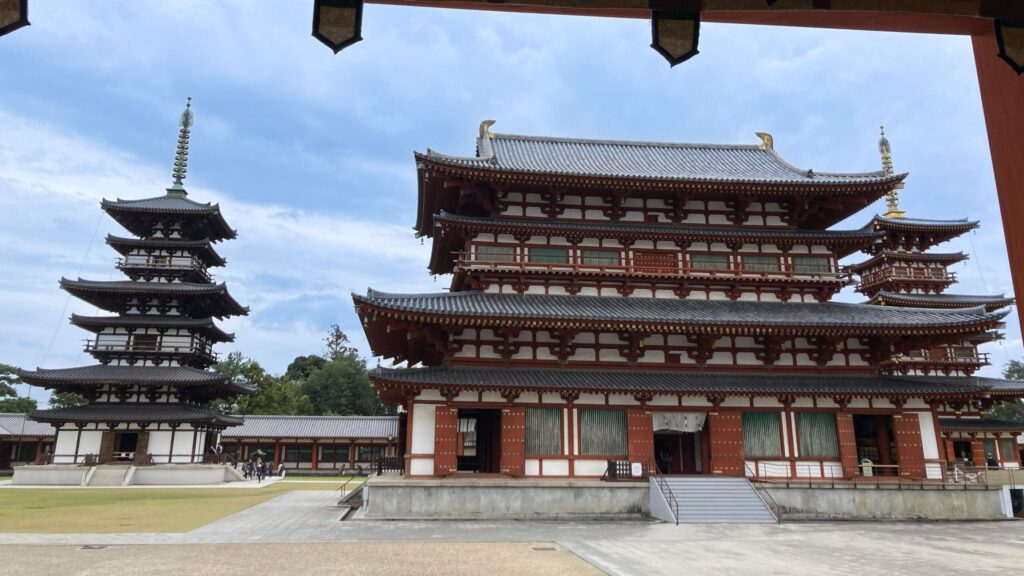
Yakushiji Temple, a UNESCO World Heritage Site in Nara, is one of Japan’s most celebrated ancient temples. Dedicated to Yakushi Nyorai, the Buddha of Healing, it has been revered for more than 1,300 years as a place of prayer for health and recovery. Yet, Yakushiji is far more than a healing temple. Its story is inseparable from Empress Jito, one of the most remarkable rulers in Japanese history. She survived the Jinshin War alongside her husband, Emperor Tenmu, endured the deaths of both her husband and her beloved son, Prince Kusakabe, and still refused to yield to fate. Ascending the throne herself, she secured her grandson's succession, strengthened the foundations of Japan’s ancient centralized state, and helped shape the imperial system that would endure for centuries. Originally founded by Emperor Tenmu to pray for Jito's recovery from illness and completed under her leadership, Yakushiji stands today not only as a symbol of their bond but also as a monument to the resilience, vision, and determination of the woman who overcame tragedy to help build the nation.
Born into Turmoil: The Early Life of Princess Uno-Sarara
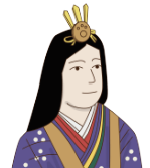
Princess Uno-Sarara (鸕野讃良), who would later become Empress Jito (645-703, 持統天皇), was born in 645, the very year of the Isshi Incident, one of the greatest coups in ancient Japanese history. Her father, Prince Naka no Ōe, later Emperor Tenji (626-672, 天智天皇), assassinated Soga Iruka (?-645, 蘇我入鹿), the most powerful statesman of the time, opening the door to a new political era. Yet from the moment of her birth, the princess was destined to live amid fierce struggles for power. Tragedy struck early in her life. Her grandfather was accused of treason and forced to take his own life along with members of his clan. The shock shattered her mother's health, and she too died the following year at a young age. Uno-Sarara was only five years old.
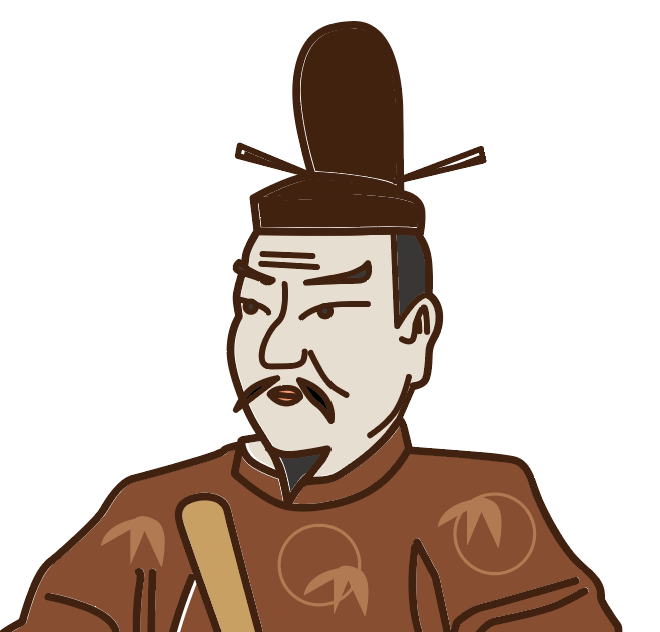
At the age of thirteen, she married her uncle, Prince Ōama (大海皇子), who would later become Emperor Tenmu (?-686, 天武天皇). By then, East Asia had entered a period of growing instability. Japan dispatched a large force in support of the Korean kingdom of Baekje, only to suffer a devastating defeat at the Battle of Baekgang in 663. Uno-Sarara accompanied Prince Ōama to Kyushu and gave birth to their first son, Prince Kusakabe (662-689, 草壁皇子), at a military base in Tsukushi on the front line of the conflict. It was a child born in the midst of war. The life of the woman who would later overcome extraordinary hardships began amid the turmoil of both political intrigue and armed conflict.
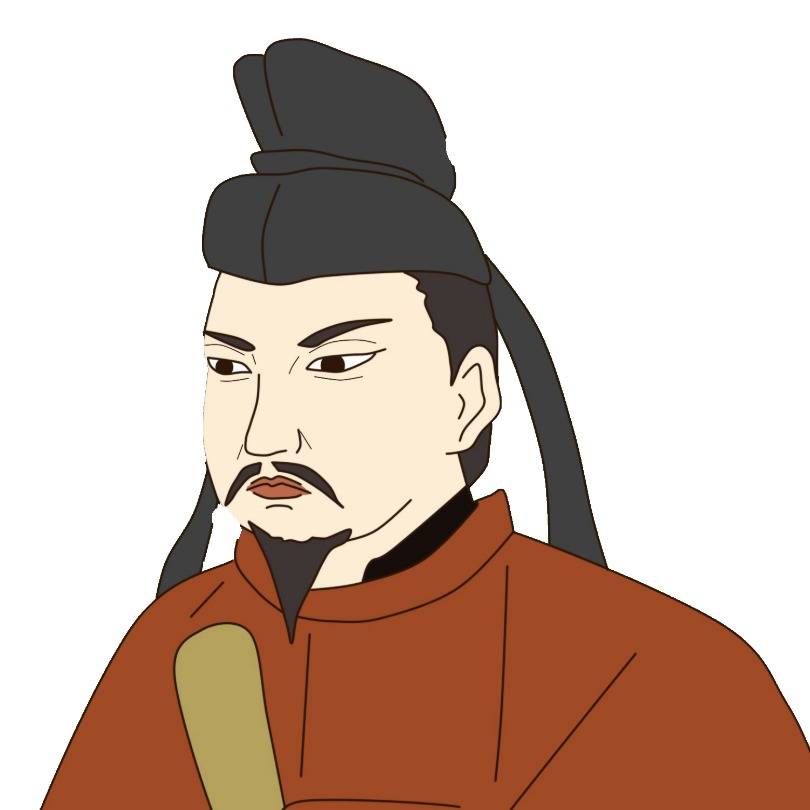
Following the defeat at Baekgang, Prince Naka no Ōe moved with remarkable speed to strengthen Japan’s defenses against a possible invasion by the Tang–Silla alliance. He ordered the construction of extensive defensive fortifications, including Mizuki and a network of mountain fortresses, and relocated the capital inland to Ōtsu Palace. In 668, he ascended the throne as Emperor Tenji. During these turbulent years, Prince Ōama served as Crown Prince, while Uno-Sarara supported her father as a royal princess, gaining valuable political experience that would later shape her own reign.
The First Trial: The Jinshin War
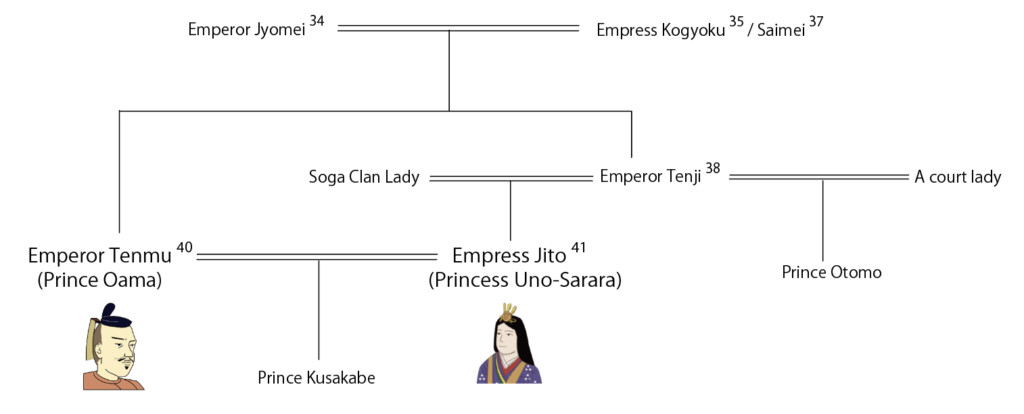
Princess Uno-Sarara’s first great trial was the Jinshin War of 672. The war erupted over the imperial succession between her husband, Prince Ōama, and Prince Ōtomo, the son of her father, Emperor Tenji. Following Emperor Tenji’s death, Prince Ōama feared for his safety and withdrew to Yoshino together with Uno-Sarara. In the bitter cold of autumn, they are said to have traveled nearly 100 kilometers through snow-dusted mountain paths. Beside Uno-Sarara were her ten-year-old son, Prince Kusakabe, and her infant son, Prince Osakabe.
At the time, imperial succession generally favored mature candidates of around thirty years of age who possessed strong royal lineage on both the paternal and maternal sides, and succession between brothers was widely accepted. Emperor Tenji, however, sought to pass the throne to the twenty-five-year-old Prince Ōtomo, whose mother came from a powerful local clan. For Uno-Sarara, this was difficult to accept. Her own son, Prince Kusakabe, possessed what was regarded as the most prestigious lineage possible, being born to two members of the imperial family.
Prince Ōama and Uno-Sarara soon gained the support of influential clans, particularly those of Owari, and took up arms against Prince Ōtomo. The result was a decisive victory for Prince Ōama. He ascended the throne as Emperor Tenmu, while Uno-Sarara became empress and entered the Asuka Kiyomihara Palace.
Trials Upon Trials: The Death of Her Husband and Her Son
At Asuka Kiyomihara Palace, Uno-Sarara stood beside Emperor Tenmu and played a central role in government affairs. During their reign, a series of reforms laid the foundations of the Japanese state. These included the adoption of the title Tennō (Emperor) in place of the earlier Ōkimi (Great King),” the change of the country’s name from Wa to Nihon (Japan), the compilation of the Asuka Kiyomihara Code, and the establishment of the Shikinen Sengū system of periodic rebuilding at Ise Grand Shrine.
In 686, Emperor Tenmu died. Without time to grieve, Uno-Sarara assumed responsibility for governing the realm until Prince Kusakabe reached an age suitable for accession. Acting as regent, she pressed forward with state-building projects, including the completion and implementation of the Asuka Kiyomihara Code in 689, the first Shikinen Sengū ceremony in 690, and the construction of Fujiwara-kyō, Japan’s first large-scale planned capital.
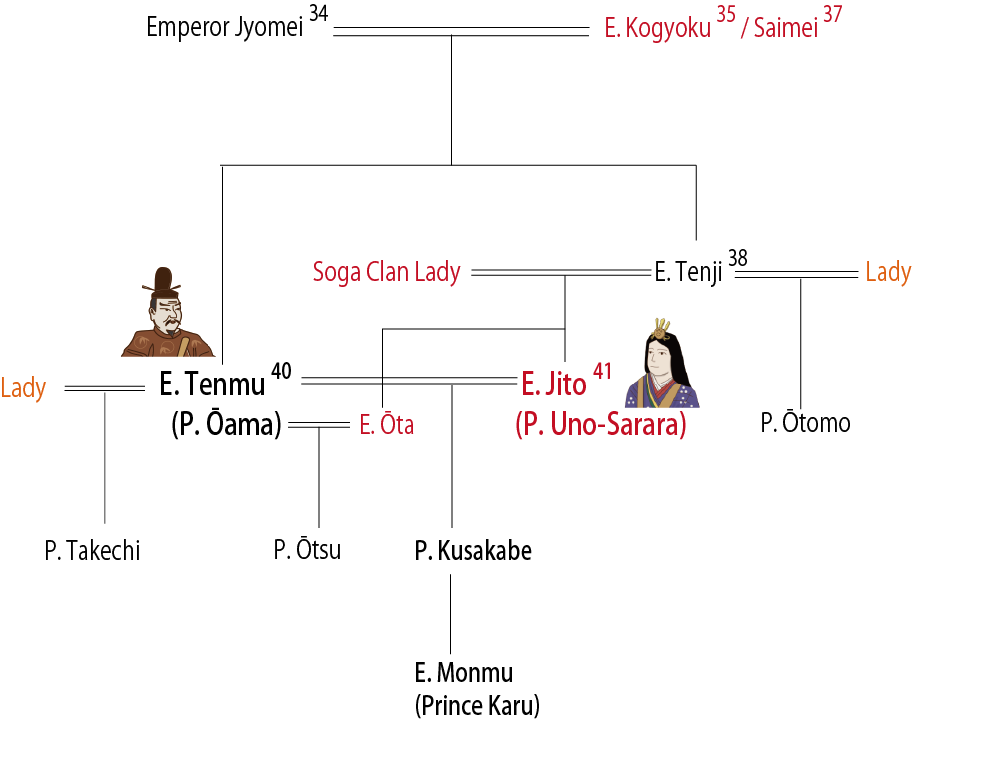
Yet a formidable obstacle stood in the way of Prince Kusakabe’s succession: Prince Ōtsu, the son of Emperor Tenmu and Princess Ōta. Older than Kusakabe, gifted with exceptional talent, and born to parents of imperial blood, Prince Ōtsu possessed impeccable credentials as a potential heir. Aware of the danger, Emperor Tenmu had previously gathered Uno-Sarara and his sons at Yoshino, where they swore an oath recognizing Prince Kusakabe as the future emperor and pledging mutual support among the princes. The oath proved short-lived. Barely a month after Emperor Tenmu’s death, Uno-Sarara ordered the arrest of Prince Ōtsu on suspicion of treason. Before a thorough investigation could take place, he was compelled to take his own life the following day.
With Prince Ōtsu removed, the greatest obstacle to Kusakabe’s accession seemed gone. All that remained was to wait for his enthronement. Fate, however, had another cruel blow in store. In 689, Prince Kusakabe died suddenly at the age of twenty-eight. Having lost her husband and devoted herself to fulfilling his vision of state-building, Uno-Sarara now suffered the loss of her beloved son as well. The depth of her grief can scarcely be imagined.
The Resilient Empress: Guiding Her Grandson to the Throne
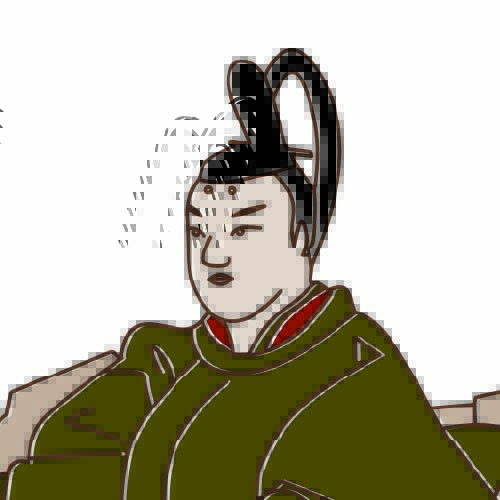
After the death of Crown Prince Kusakabe in 689, Uno-Sarara made a momentous decision. In 690, she ascended the throne as Empress Jito. Her primary objective was to secure the succession of Kusakabe’s son, Prince Karu, later Emperor Monmu (683-707, 文武天皇). At the time, the young prince was only seven years old, and other sons of Emperor Tenmu remained potential candidates for the throne. By becoming the empress herself, Jito gained the time her grandson needed to mature.
One of the most influential figures of the age was Prince Takechi, Emperor Tenmu’s eldest son and the celebrated commander of the Jinshin War. Respected by both the imperial family and the powerful clan, he could not simply be removed. Instead, Empress Jito appointed him Daijō-daijin, the highest office of state, integrating him into the center of government while maintaining political stability. At the same time, she carefully prepared the path for Prince Karu’s succession. When Prince Takechi died of illness in 696, the final obstacle disappeared. The following year, Prince Karu was named Crown Prince. In August 697, Empress Jito abdicated. Prince Karu ascended the throne as Emperor Monmu at the age of fifteen—an exceptionally young age by the standards of the time. His accession marked a significant shift in imperial succession, strengthening a direct hereditary line from Emperor Tenmu through Prince Kusakabe to Emperor Monmu, rather than the traditional pattern of succession among brothers. The lifelong ambition that Jito had pursued through the deaths of her husband and her beloved son had finally been fulfilled.
Maintaining State Order and Stabilizing Imperial Succession
Empress Jitō, together with her husband Emperor Tenmu, victor of the Jinshin War, laid the foundation for political centralization by restraining powerful clans and promoting kōshin seiji (rule centered on the imperial family). At the same time, imperial succession was generally based on succession among brothers, allowing multiple princes to emerge as legitimate heirs whenever the throne changed hands. Having witnessed the Jinshin War herself, Jitō understood that succession disputes were not merely internal family matters but conflicts capable of destabilizing the entire state. To preserve a centralized state, she advanced the development of the ritsuryō governing system while clarifying succession through the lineage of Prince Kusakabe in order to prevent future succession struggles. Even if this involved tolerating the exclusion of other imperial princes, such decisions may be seen as reflecting an ancient ruler’s responsibility: to preserve order for the many, even at the cost of sacrifice by the few.
The Completion of Yakushiji Temple
Yakushiji Temple, originally commissioned by Emperor Tenmu in 680 to pray for the recovery of his empress, was finally completed in 697 with the consecration of its principal image, Yakushi Nyorai, the Buddha of Healing. Just one month later, Empress Jito abdicated, and Prince Karu ascended the throne as Emperor Monmu. Between those two events lay a remarkable journey. Jito had lost both her husband and her son, yet she had ascended the throne herself, guided the construction of a new state, and secured her grandson's succession.
Today, Yakushiji stands as more than an ancient temple. It remains a testament to the vision of Emperor Tenmu and Empress Jito, and to the extraordinary resilience of the empress who overcame tragedy to help shape the foundations of Japan.
Emperor Jito's Timeline
| Years | Events | Age |
|---|---|---|
| 645 | Princess Uno-Sarara (Emprrdd Jito) is born | 1 |
| 645 | Soga Iruka is assassinated by Prince Naka-no-Ōe (Isshi Incident) | 1 |
| 649 | Soga Ishikawamaro, grandfather of Uno Sarara, is forced to commit suicide | 4 |
| 649 | Ochi Itsurume, mother of Uno Sarara, passes away | 5 |
| 657 | Uno-sarara marries Prince Ōama (Emepror Tenmu) | 13 |
| 662 | Uno-Sarara gives birth to Prince Kusakabe | 17 |
| 663 | The Battle of Baekgang | 18 |
| 668 | Emperor Tenji (Prince Nakano-Oe) ascends the throne | 23 |
| 671 | Prince Ōama and Princess Uno-Sarara flee from Asuka to Yoshino | 27 |
| 672 | Emperor Tenji passes away | 28 |
| 672 | Jinshin War | 28 |
| 673 | Emperor Tenmu ascends the throne | 29 |
| 679 | The Vow of Yoshino: Declaring Prince Kusakabe as the imperial successor | 35 |
| 680 | Emperor Tenmu vows to build Yakushiji Temple | 36 |
| 680 | Genmei marries Prince Kusakabe at latest before 680 | 36 |
| 683 | Genmei gives birth to Prince Karu (later Emperor Monmu) | 39 |
| 685 | Emperor Tenmu establishes the Shikinen Sengu system | 41 |
| 686 | Emperor Tenmu passes away | 42 |
| 686 | Prince Ōtsu is forced to commit suicide | 42 |
| 689 | Prince Kusakabe passes away | 45 |
| 689 | The Asuka Kiyomihara Code is completed | 45 |
| 690 | Empress Jito ascends the throne | 46 |
| 690 | Empress Jito conductsthe first Sikinen Sengu at Naiku | 46 |
| 692 | Empress Jito conductsthe first Sikinen Sengu at Geku | 48 |
| 694 | The capital moves to Fujiwara-kyo | 50 |
| 696 | Prince Takeichi passes away | 52 |
| 697 | Emperor Monmu ascends the throne | 53 |
| 698 | Yakushiji Temple is completed | 54 |
| 701 | The Taiho Code is completed | 57 |
| 702 | Empress Jito passes away | 58 |
Recommendations to Visit
Yakushiji Temple
- Access: From Kintetsu-Nara Sta. Transfer at Yamato-Saidaiji Sta. Get off at Nishinokyo Sta. (1-min walk)