Shugakuin Imperial Villa: Emperor Gomiziunoo's Villa Life
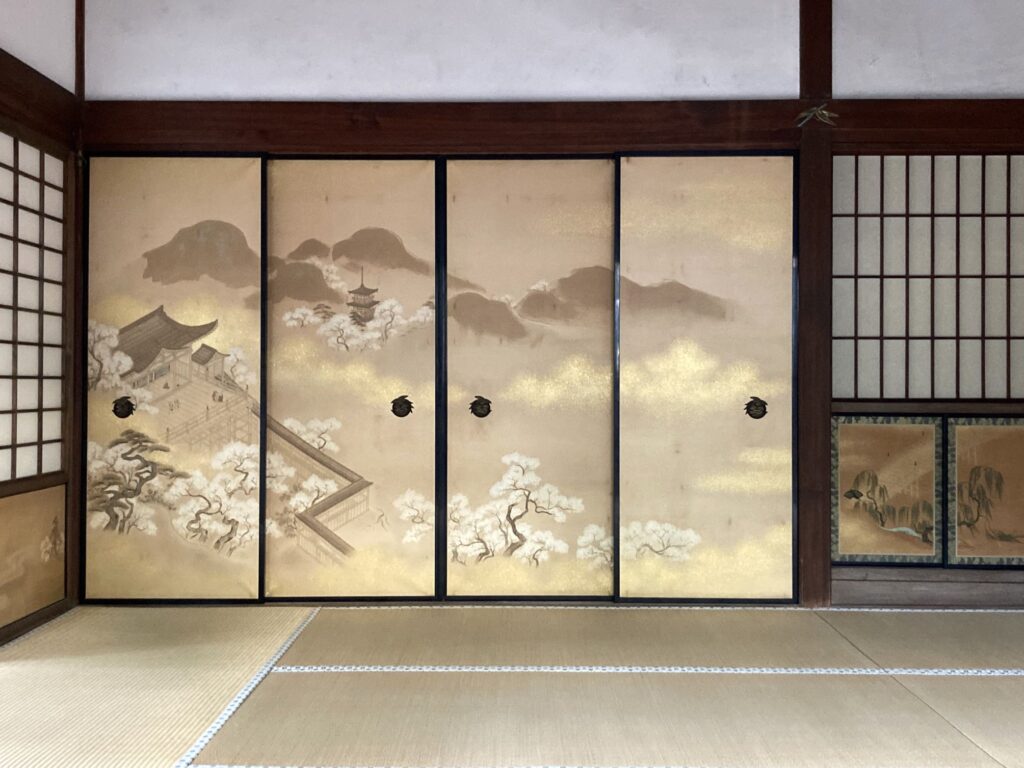
Shugakuin Imperial Villa is surrounded by a courtly atmosphere, and its beauty is beyond description. This magnificent villa was built by the 108th Emperor Go-Mizunoo (1596-1680, 後水尾天皇) after his abdication. Emperor Go-Mizunoo ascended to the throne at a young age as the Tokugawa shogunate consolidated its solid political system in pursuit of a centralized feudal system. He was forced to spend his days of patience and obedience at a turning point in an era when the emperor's power and authority gradually came under the shogunate's control. His waka (Japanese poetry), reveals his sentiment. "Looking back on my long life, it was dreary. Flowery white snow covered the hill that first looked like a high peak." Let us uncover his life under the turning point in Japanese history, when the political power of the Tokugawa shogunate had gained.
Shugakuin Imperial Villa, Awe-Inspiring Beauty
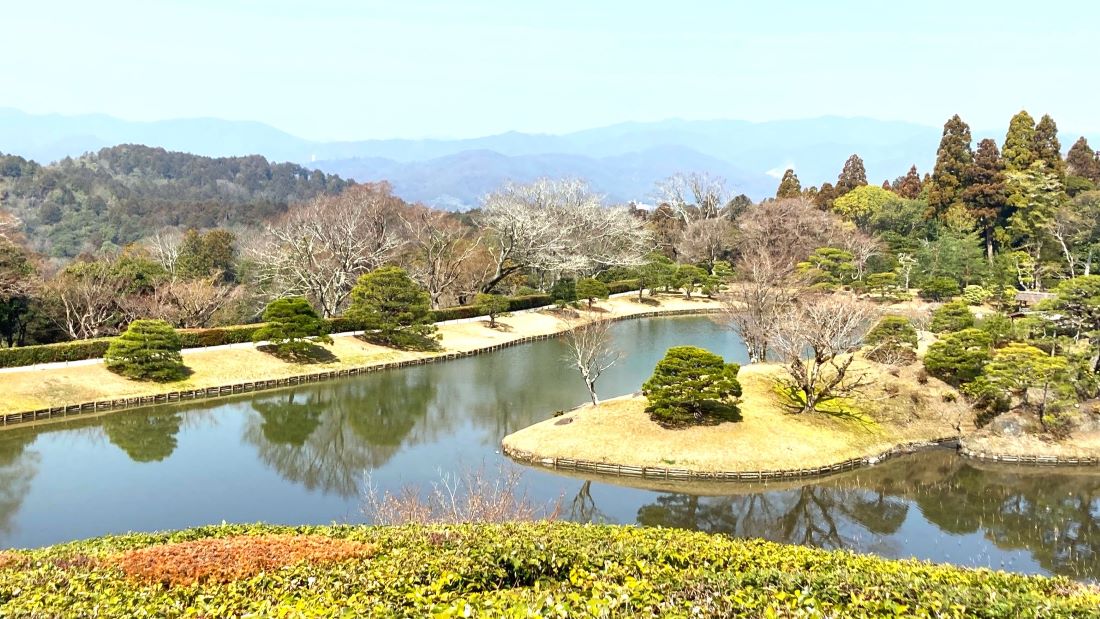
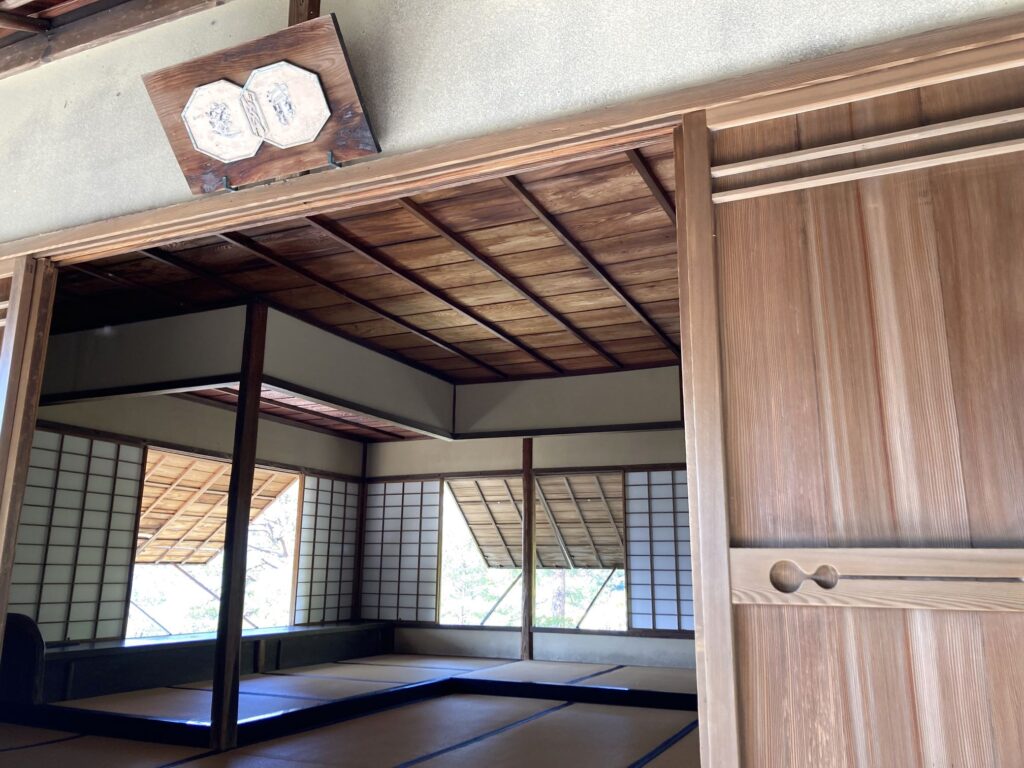
The villa encompasses upper, middle, and lower gardens, interconnected by a meandering pathway that spans across 5 hectares of hills on the western side of Mt.Hiei. The upper garden showcases a sizable pond called Yokuryuchi, situated at an elevation of 140 meters above sea level. This pond was created by damming three mountain streams and is artfully designed to look like a large dragon bathing. The panoramic vista from the upper garden, particularly during the enchanting autumn sunsets, is truly breathtaking. The vibrant crimson foliage casts a mesmerizing reflection upon the serene surface of the pond, adding to the overall allure of the scene.
Pressure from the Tokugawa shogunate, One after Another
Emperor Go-Mizunoo faced the first pressure with the introduction of a new law known as a set of regulations that applied to the emperor and the court nobles, issued in 1615. This historical law imposed strict regulations on the political involvement of the emperor and court nobles, restricting their speech and actions. The pressure continued. Tokugawa Ieyasu (1543-1616, 徳川家康) urged Emperor Go-Mizunoo to make Tokugawa Lady, Masako (1607-1678, 徳川和子), a granddaughter of Ieyasu, his lawful wife in 1620. This marked the first marriage between an emperor and a samurai lady in Japanese history. As a result, despite already having a prince and a princess with his beloved lady, Emperor Go-Mizunoo was compelled to part ways with her. Furthermore, six years later, Emperor Go-Mizunoo received an invitation to visit Nijo-jo Castle, which symbolized the power and authority of the Tokugawa shogunate. This was a significant departure from the traditional protocol, as it was customary for the samurai to come to the imperial palace rather than the emperor going to a follower's castle. Following this event, the emperor was restricted from leaving the Kyoto Imperial Palace for nearly 240 years, until the end of the Edo Period (1603-1868). The “Shie Incident” followed this, which was extremely shocking to Emperor Go-Mizunoo. The Tokugawa shogunate divested the high Buddhist priests of their purple robes, given to them by Emperor Go-Mizunoo, and exiled them. This meant that the Tokugawa shogunate reversed the emperor’s decision.
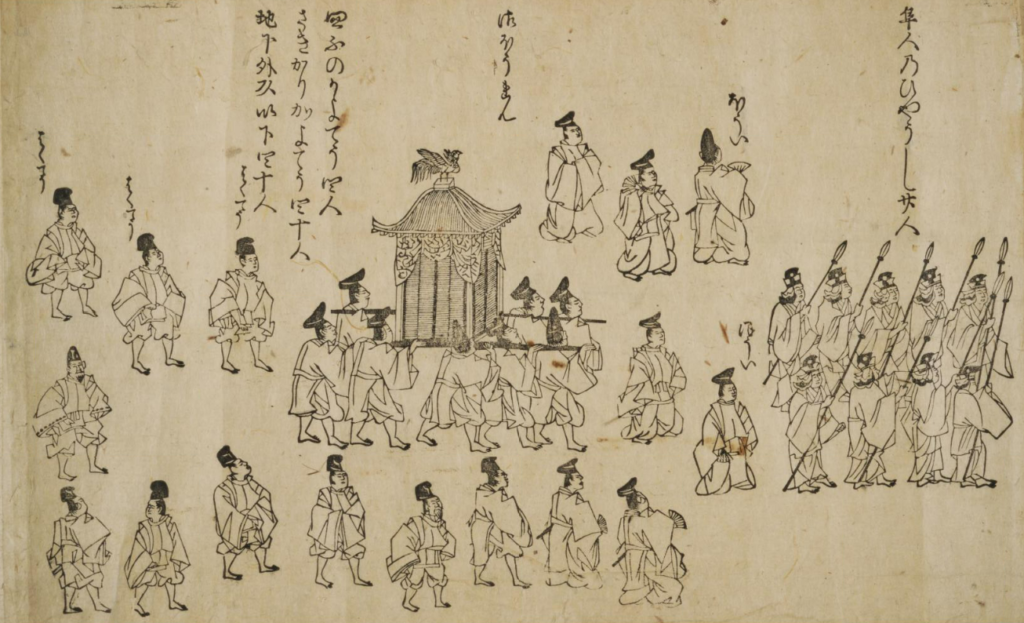
『〔寛永行幸記〕』〔下巻〕,〔寛永4-5 (1627-1628) 頃〕.
国立国会図書館デジタルコレクション https://dl.ndl.go.jp/pid/1288239 (参照 2023-05-25)
Let me refrain from thinking. The State of Giving Up the Mind of Emperor Go-Mizunoo
Confronted with the pressure exerted by the Tokugawa shogunate, he composed one waka: Live comfortably in this world, anxious if care, let me refrain from thinking (世の中をきらくにくらせ何事も おもえばおもふ 思はねばこそ). This poetic expression encapsulated his intricate emotions of resentment, resignation, and philosophical contemplation regarding his life amidst the indignation, humiliation, and eventual acceptance of Tokugawa’s power. Subsequently, for more than 260 years, starting from that point until the late Edo period, the political power of the emperor and the Imperial Court waned, receding from the forefront of Japanese politics. He presented the framed statement, or hengaku, displaying the Kanji character “Shinobu (忍),” meaning “Patience,” to Maeda Toshitsune (1594-1658, 前田利常), the third Lord of the Kaga domain. They seemed to share a sentiment: “Be patient in the face of the powerful Tokugawa shogunate to preserve and eventually win through superior cultural development.”
Counterattack Against the Tokugawa shogunate, Abdication to his Princess

In 1629, the desperate Emperor Go-Mizunoo, stripped of his political power and authority, executed the abdication of his Princess secretly at the age of 32. After that, he was called Go-Mizunoo-in. This thwarted the Tokugawa shogunate’s aspirations to become the emperor's maternal relatives. Because it was a consuetude that the empress was destined to be alone for the rest of her life. The following three emperors were Go-Mizunoo’s sons born as court noblewomen rather than the Tokugawa lady.
Go-Mizunoo-in, the Center of the Imperial Court Salon
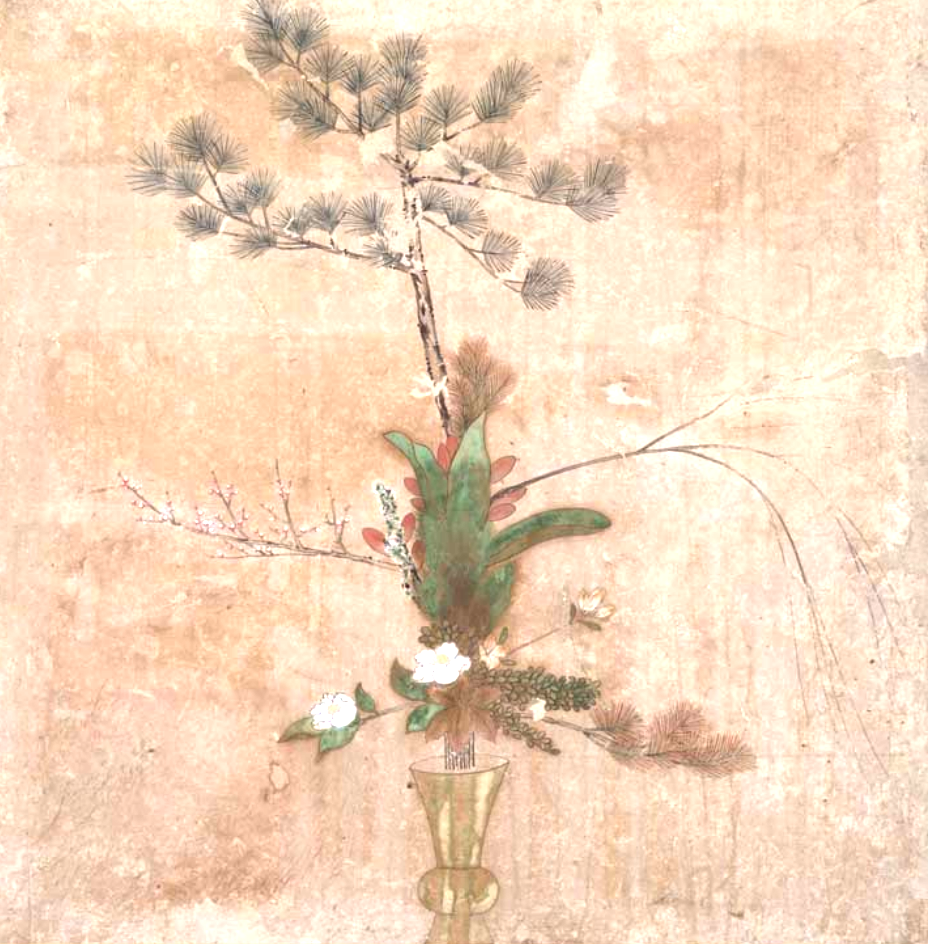
Source: 東京国立博物館
As left with only the realms of academia and culture, Go-Mizunoo-in wholeheartedly devoted himself to traditional Japanese court cultures such as waka and flower arrangement, following the ancient customs outlined in “Yusoku-kojitsu”, the preservation of Imperial rituals and court classics that had endured for more than 1,000 years. This can be attributed to a renewed awareness of the legitimacy of the imperial lineage amidst the friction with the shogunate. The court salons thrived with gatherings centered around waka and rikka. Rikka is the elaborate flower arrangement style featuring a tall central tree surrounded by low grass – an artistry that distinguished Go-Mizunoo-in. Over six months, more than 30 flower banquets were hosted. Many court nobles participated in these banquets to compete for the quality of their Rikka. Like a Rikka frenzy, a frenzy of excitement was generated around the court, centering on Emperor Go-Mizunoo. In addition, he inherited the secret teachings of the Kokin Wakashu, Japan's inaugural poetry anthology, from his uncle, Prince Toshihito (1579-1629, 八条宮智仁親王). He compiled a personal collection titled “Go-Mizunoo-in-Shu”, featuring his handpicked 20 waka compositions. Notably, for the thirty-third anniversary of Tokugawa Ieyasu’s passing, he created Kumode-no-Waka, or waka arranged like a spider's web, with a waka formed in every row, column, and diagonal; the 24 surrounding characters held symbolic meanings, collectively offering a prayer for Ieyasu’s commemoration. This exemplifies Go-Mizunoo-in’s remarkable proficiency in waka poetry.


Go-Mizunoo-in Enjoyed Walking in the Shugakuin Imperial Villa with Masako
Go-Mizunoo-in personally supervised the villa’s creation, meticulously overseeing the placement of miniature stones, trees, grass, and other elements on its miniature hill through numerous trials. It is plausible that he attained a philosophical outlook on life during his involvement in this project. In 1658, Go-Mizunoo-in visited the Katsura Imperial Villa, seeking inspiration from its design and architecture as a reference for the construction of Shugakuin Rikyu. Completing this villa at age 59, Go-Mizunoo-in enjoyed visiting the villa more than 70 times with Masako, who finally became his beloved lady. He occasionally organized villa tours, inviting court nobles and ordinary people. These tours included activities such as exploring several tea houses, boating at Yokuryuchi Pond, and enjoying banquets. His last waka before his death reads,
“Looking back on my long life, it was filled with sorrow. However, the hill, now covered in beautiful white snow, which once appeared as a towering peak. (ゆきゆきて 思へばかなし 末とほく みえしたか根も 花の白雪),”
seems to reflect his contentment and fulfillment of a life lived to the fullest. He passed away in 1680 at the age of 85, bringing an end to his patient and eventful life. Please take a stroll through the spacious Shugakuin Imperial Villa, and contemplate Go-Mizunoo-in’s life, which was divorced from politics but focused on cultural pursuits.
Emperor Go-Mizunoo Timeline
| 1596 | Emperor Go-Mizunoo was born | Age =1 | Momoyama Period |
| 1600 | Tokugawa Ieyasu defeated Ishida Mitsunari, Hideyoshi's right arm at the battle of Sekigahara | 4 | |
| 1603 | Ieyasu estabished Tokugawa shogunate at Edo | 6 | Edo Period |
| 1603 | Ieyasu built Nijo-jo Caslte | 6 | |
| 1611 | Emperor Go-Mizunoo was enthroned | 15 | |
| 1615 | Issued a set of regulations that applied to the emperor and the court nobles | 18 | |
| 1620 | Tokugawa Masako married Emperor Gpmizunoo | 23 | |
| 1625 | Emperor Go-Mizunoo inherited the secret teachings of the “Kokin-waka-shu” | 28 | |
| 1626 | Emperor Go-Mizunoo visited Nijo-jo Castle | 29 | |
| 1627 | Shie Incident | 30 | |
| 1629 | Emperor Go-Mizunoo executed the abdication | 32 | |
| 1629~ | More than 30 flower banquets were hosted by Go-Mizunoo-in | 32 | |
| 1655 | The Shugakuin Imperial Villa was constracted | 59 | |
| 1678 | Go-Mizunoo-in compiled a personal anthology, "Go-Mizunoo-in-Shu" | 82 | |
| 1680 | Go-Mizunoo-in passed away | 85 |
Recommendations to visit
- Access: 1 hour from Kyoto Station. Take bus #5 bound for "Iwakurashojyamae (岩倉総社前)” at A1. Got off at "Shugakuin Rikyu-michi (修学院離宮道)" bus stop, then a 15-minute walk. → more information
- You must apply with the Imperial Household Agency on the official website