Chion-in Temple and Honen's Buddhist Revolution in Medieval Japan
In the chaotic final years of the Heian period (794–1185), the Buddhist monk Honen (1133–1212, 法然) transformed Japanese Buddhism with a simple but revolutionary teaching that anyone could attain salvation through Senju Nembutsu, the single-minded recitation of Amida Buddha’s name. His teaching gave hope to ordinary people suffering through war, famine, and disaster, and led to the founding of the Jodo sect. However, it was considered too radical by many conventional Buddhist schools.
Today, Chion-in stands as the head temple of Jodo Buddhism on the site where Honen passed away, and Honen’s teachings continue to inspire people.

War, Famine, and the Struggle for Survival
Honen lived about 100 years after the "Age of the Final Dharma," which was believed to have begun in 1052. During this age, the widely read Ojoyoshu, a how-to book on achieving an ideal moment to be reborn in the Pure Land, reflected two concepts: Onriedo (abhorrence of living in this impure land) and Gongujodo (seeking rebirth in the Pure Land).In the mid-12th century, Japan fell into political turmoil through conflicts such as the Hogen and Heiji Disturbances, followed by the Genpei War (1180–1185) between the Minamoto and Taira clans. After being defeated by Taira no Kiyomori, Minamoto no Yoritomo was exiled to Izu, but later returned to overthrow the Taira clan and then established the Kamakura shogunate. As warfare spread across Japan, ordinary people suffered greatly from chaos and destruction. In addition, a famine broke out in 1181, resulting in massive deaths from starvation and an exodus of farmers who abandoned their lands and rushed to Kyoto to escape hunger caused by the devastation of the rural areas, leading to the collapse of social order.
Honen Makes Pure Land Entry Possible Without Asceticism

Buddhism in Japan initially developed as a religion of state protection for the Imperial Court and nation. During the Heian period (794–1185), monks such as Saicho and Kukai pursued enlightenment through rigorous study and ascetic practice in mountain temples such as Enryakuji and Koyasan Kongobuji.
Honen himself trained at Enryakuji but failed to attain enlightenment or find a path to salvation accessible to all. Therefore, he searched for "a way that even a fool like me could be saved", or “Buddhism for salvation". After reading numerous sutras, he finally found one sentence in the Kangyosho (Commentary on the Meditation Sutra, 観経疎): If you single-mindedly chant the name of Amitabha Buddha, you will surely be reborn in the Pure Land. In 1175, when Honen was 43 years old, he found the way to save the people by chanting "Namu Amidabutsu" (Amida Buddha). He then left Enryakuji, devoted himself to the Nembutsu practice alongside his followers at his humble retreat, Honen-in, and founded the Jodo sect to offer salvation to people. His revolutionary doctrine attracted many people because it was very simple. Through the practice of Senju Nembutsu—the single-minded recitation of Amida Buddha’s name—ordinary people could transcend the Six Realms and attain rebirth in the Pure Land of Ultimate Bliss without rigorous ascetic practices.
Save Those Who Cannot be Saved by Conventional Teaching
Honen’s doctrine was too radical for conventional Buddhists to accept because it overturned the traditional Buddhist belief that strict training, magnificent temples, and close ties with political authority were essential for salvation. In 1207, the Imperial Court finally imposed severe punishments, including capital offenses for four people and exile for eight. Honen was exiled to Sanuki (Kagawa Prefecture) at the age of 75. Five years later, he was forgiven and returned to Kyoto, but he passed away the following year at the age of 80. Honen's follower, Shinran (1173-1263, 親鸞), spread Honen's true doctrine about Senju-Nembutsu.
The Legacy of Honen and Chion-in Temple
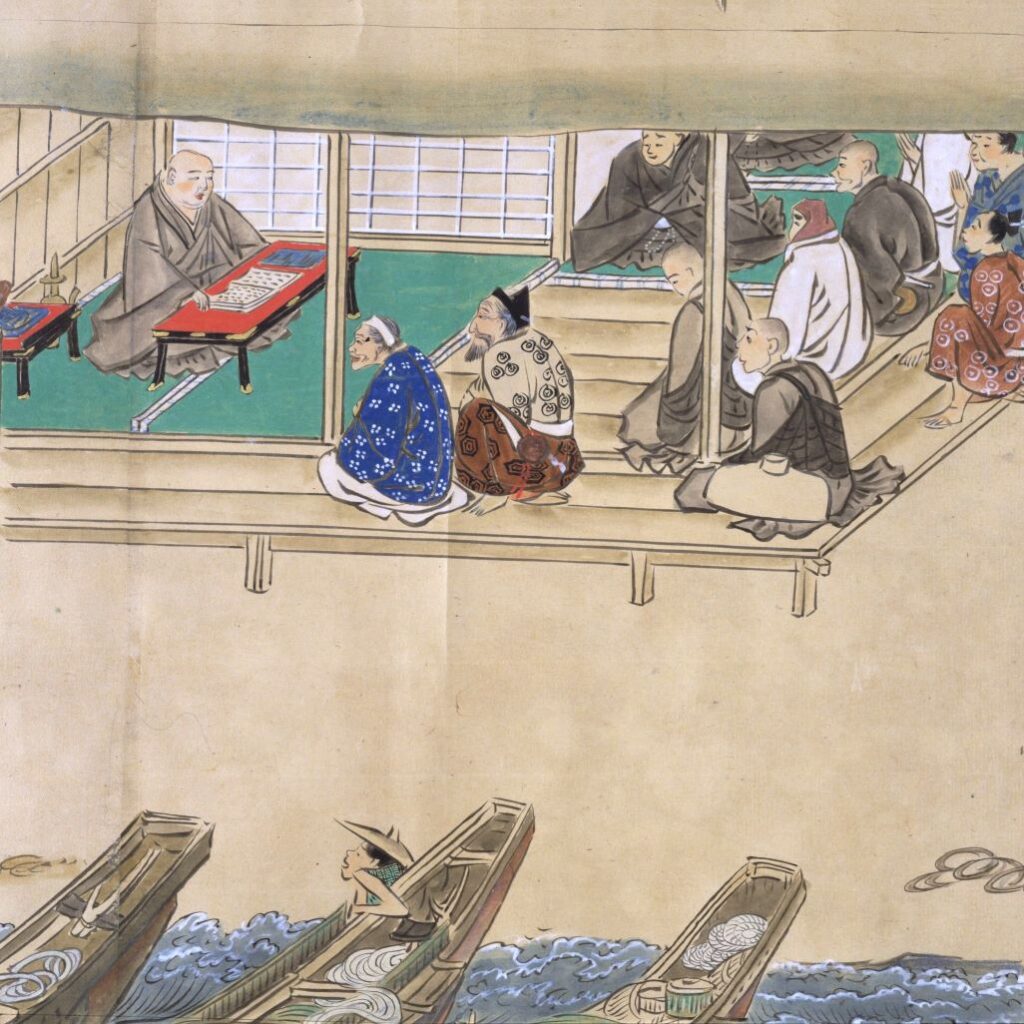
Built on the site where Honen passed away, Chion-in developed as the head temple of the Jodo sect. During the Edo period, it flourished under the patronage of Tokugawa Ieyasu, who deeply revered Jodo Buddhism, alongside Zojoji, the Tokugawa family temple in Edo.
Among Chion-in’s most remarkable features is its monumental Sanmon Gate, a National Treasure and one of the largest wooden temple gates in Japan, built through the patronage of the Tokugawa shogunate. The gate remains a powerful symbol of the history and faith of Jodo Buddhism today.
Honen and Shinran Timeline
| 1133 | Honen was born | 1 | Heian |
| 1145 | Honen started to study Buddhism at Hieizan Enryakuji Temple | 13 | |
| 1052 | "Age of the Final Dharma" was believed to begin in 1052 | 20 | |
| 1156 | Hogen war | 24 | |
| 1159 | Heiji war | 27 | |
| 1173 | Shinran was born | 41 | |
| 1175 | Honen attained Senju Nenbutsu | 43 | |
| 1185 | Minamoto no Yoritomo established Kamakura shogunate | 53 | Kamakura |
| 1186 | Honen debated Senju Nenbutsu with Tendai sect's Buddhists | 54 | |
| 1201 | Shinran stadied under Honen | 69 | |
| 1211 | Honen was forgiven for his exile. | 79 | |
| 1212 | Honen passed away | 80 |
Recommendations to visit
Chion-in Temple
- Access: 30 minutes from Kyoto Station. Take bus #206 bound for Karasumakitaoji at A2 or D2. Get off at Chion-in-mae bus stop, then a 5-minute walk.
Zojo-ji Temple
- Access: 3-minute walk from Onarimon or Shibakoen Stations of the Toei Mita Line of the Tokyo Metropolitan subway
_s-300x169.jpg)