Bosen Tea Room – Kobori Enshu, Master of the Tea Ceremony and the Aesthetic of Kirei-Sabi
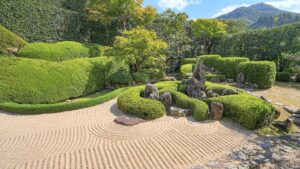
Bōsen, located within the subtemple Koho-an (Kohō-an) of Daitoku-ji in Kyoto, is one of the most remarkable tea rooms created by Kobori Enshū, one of Japan’s three great tea masters. Designed in the shoin style with a spacious twelve tatami mats layout, it elevates the spirit of Wabi-cha through the elegance and discipline of samurai culture - an expression of the philosophical beauty known as kirei-sabi perfected by Enshū.
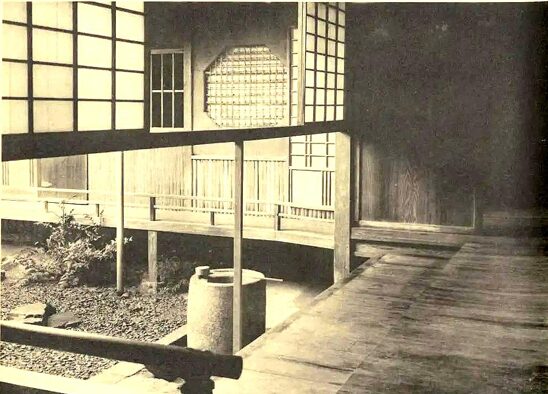
Its most distinctive feature is the shoji screens installed only along the upper half of the veranda. Light filtering gently through the paper screens contrasts with the natural light entering from the open lower section, reflecting softly across the broad engawa and the white gofun-plastered ceiling. This interplay of light creates a soft, luminous shimmer within the room. The composition, which frames the garden beyond a central sill, enhances a sense of depth. The opening beneath the shoji also functions as a nijiriguchi (crawling entrance), embodying the functional elegance of the tea room.

The name Bōsen derives from a passage in the Zhuangzi: “Once the fish is caught, the fish trap is forgotten; once the rabbit is snared, the trap is forgotten.” The phrase suggests that once the essence is attained, the tools themselves can be left behind. This Zen-like idea of transcending form and instrumentality resonates deeply with the philosophy of tea. In this sense, Bōsen can be seen as the crystallization of kirei-sabi—the aesthetic culmination of Enshū’s life and thought.
Kirei-Sabi — The Aesthetic Realm Kobori Enshū Ultimately Attained
Kobori Enshū (born Kobori Masakazu, 1579–1647, 小堀遠州) lived through the turbulent transition from the Warring States period to the early Edo era. He served the Tokugawa shogunate as sakujibugyō (commissioner of public works) and as tea master and instructor to the Tokugawa shoguns. He was also a renowned garden designer and is regarded as one of Japan’s three great tea masters, following Sen no Rikyu and Furuta Oribe.
Deeply moved by the teaching of Murata Juko, the spiritual founder of the tea tradition — “Be beautiful from within your heart” — Enshu pursued the essence of beauty through waka poetry, Zen, and chanoyu (the Way of Tea). His aesthetic was luminous and refined, a world of elegance that seemed to reflect the very sensibility of the Japanese spirit.
Enshu studied tea under Furuta Oribe. While Sen no Rikyū, who perfected Wabi-cha, pursued an introspective, serene aesthetic, Oribe developed a bold, dynamic style that reflected the vibrant Momoyama culture. Inheriting this lineage, Enshu added elegance and brightness to wabi-sabi, completing a new aesthetic ideal that harmonized with the emerging samurai society.
He also deeply admired Fujiwara no Teika, a court noble and poet of the late Heian and early Kamakura periods, and devoted himself to the study of waka poetry. By drawing on the elegant courtly tradition of the Heian period (794-1885), he incorporated the refined sensibility of classical waka into the world of tea; his gaze was always directed toward the “heart” that lies beneath beauty itself. This distinctive aesthetic worldview later came to be known as kirei-Sabi.
Enshū’s Tea Gatherings — About 400 Held During His Lifetime
Kobori Enshū hosted approximately 400 tea gatherings during his lifetime. The participants came from a wide range of backgrounds, including daimyo (feudal lords), court nobles, Buddhist monks, townspeople, and artisans. Among the guests were Honda Masakatsu—the grandson of Honda Tadakatsu, one of Tokugawa Ieyasu's Four Great Retainers—and Sakai Tadayo, who had served Ieyasu since his Mikawa days and later became a senior councilor of the Tokugawa shogunate. The Zen monk Konchiin Suden, an important political advisor to Ieyasu, also attended. Records also mention Takuan Sōhō and the Zen monk Kōgetsu Sōgan, who, together with Enshū, founded the sub-temple Koho-an within Ryukoin at Daitoku-ji. Artists such as Hon’ami Kōetsu and Tawaraya Sōtatsu—considered founders of the Rinpa school—were also among the participants. Through such gatherings, Enshū helped develop the culture of tea into an aesthetic that embraced the diverse arts and cultural traditions of Japan.
In 1623, Enshū was appointed Fushimi magistrate. He built a new magistrate’s residence equipped with tea rooms, including a sukiya-style space for the practice of tea, where he regularly welcomed guests while carrying out his official duties.
Enshū also participated in what is often called the Kan'ei Salon, a cultural circle centered around Emperor Go-Mizunoo that brought together court nobles and cultured townspeople devoted to the arts of taste. Through these interactions, he furthered cultural exchange through tea. His close relationship with Emperor Go-Mizunoo is also reflected in his later involvement, as sakujibugyō, in the construction and garden design of the Sentō Imperial Palace, the residence of the retired emperor.
Mittan Tea House — Distinguished by the Mittan Alcove for the Calligraphy of Zen Master Mittan
The tea room Mittan, created by Enshū in his mid-fifties, is regarded as one of the three extant National Treasure tea houses, alongside Rikyū’s Tai-an and Urakusai’s Jo-an.
Built as a four-and-a-half mat room and integrated into the shoin of Ryūkō-in, it reflects the refined architectural style of a daimyo tea master, complete with a built-in desk alcove and staggered shelves. Its most distinctive feature is one of its two tokonoma alcoves—the “Mittan-doko.” This alcove was created solely to display the only surviving calligraphy of the Southern Song Zen monk, Master Mitsuan Xianjie. The inscription reads: If one continues one’s practice without faltering, one will attain a noble realm never imagined even in dreams.

Enshū established the formal Enshū school of tea, whose spirit continues to this day. In his Kakisute no Fumi, the instructional text he left to his disciples, he set forth the essential principles of the Way of Tea: The Importance of Being Beautiful from Within.
Kobori Enshu Timeline
| 1579 | Kobori Masakazu is born | Age=1 |
| 1591 | Rikyu Hara-Kiri | - |
| 1593 | Kobori Enshu learns Chonoyu from Oribe | 15 |
| 1595 | Kobori Mastsugu becomes a retainer of Toyotomi Hideyoshi | 17 |
| 1598 | Hideyoshi passes away | - |
| 1599 | Kobori Masakazu holds his first tea ceremony | 20 |
| 1600 | The Battle of Sakigahara | 21 |
| 1604 | Kobori Masakazu enters the service of Tokugawa Ieyasu. | 26 |
| 1606 | Kobori Masakazu oversees construction works at Edo Castle. | 28 |
| 1608 | Kobori Masakazu appointed Commissioner of Works for Sunpu Castle. | 30 |
| 1608 | Kobori Masakazu supports building Mittan tea room | 30 |
| 1612 | Kobori Masakazu appointed Commissioner of Works for the main keep of Nagoya Castle. | 34 |
| 1613 | Kobori Masakazu appointed Commissioner of Works for the Imperial Palace of Emperor Go-Mizunoo. | 35 |
| 1614 | Kobori Masakazu appointed Commissioner of Repairs for Bitchū Matsuyama Castle. | 36 |
| 1614 | Kobori Masakazu designs Raikyuji Temple Garden | 36 |
| 1616 | Tokugawa Ieyasu passes away. | ー |
| 1617 | Kobori Masakazu appointed Commissioner of Works for the Honmaru and shoin of Fushimi Castle. | 39 |
| 1618 | Kobori Masakazu appointed Commissioner of Works for the palace of Princess Kazuko (later Tōfukumon-in), consort of Emperor Go-Mizunoo. | 40 |
| 1618 | Kobori Masakazu designs Konchiin tea room | 40 |
| 1620 | Kobori Masakazu appointed Commissioner of Works for the main gates and related structures of Osaka Castle. | 42 |
| 1622 | Kobori Masakazu appointed Governor (Bugyō) of Ōmi Province. | 44 |
| 1623 | Kobori Masakazu appointed Fushimi Bugyō (Magistrate of Fushimi). | 45 |
| 1624 | Kobori Masakazu appointed Commissioner of Works for Nijō Castle and the Gyokō Palace (Imperial Visitation Palace). | 46 |
| 1626 | Emperor Go-Mizunoo visits Nijō Castle. | ー |
| 1626 | Kobori Masakazu appointed Commissioner of Works for the main keep and Honmaru of Osaka Castle. | 48 |
| 1628 | Kobori Masakazu appointed Commissioner of Works for the Ninomaru Palace of Nijō Castle. | 50 |
| 1628 | Kobori Masakazu holds more than 30 tea ceremonies, inviting 150 guests in total | 50 |
| 1629 | Completion of the Yamazato tea garden at the West Bailey of Edo Castle. | 51 |
| 1629 | Completion of Konvhiin's Hassō-seki (Eight-Window Tea Room) | 51 |
| 1630 | Completion of works as Commissioner for the Sentō Imperial Palace. | 52 |
| 1631 | Tea gathering held at the West Bailey of Edo Castle. | 53 |
| 1632 | Completion of the garden at Nanzen-ji Temple. | 54 |
| 1632 | Kobori Masakazu holds tea ceremony every day from Dec.11 to 25th. | 54 |
| 1633 | Kobori Masakazu appointed Commissioner of Works for the sukiya-style structures of the Honmaru at Nijō Castle. | 55 |
| 1640 | Construction of the shoin and Shōkin-tei at Katsura Imperial Villa. | 62 |
| 1640 | Kobori Masakazu holds more than 64 tea ceremonies, inviting 262 guests in total | 62 |
| 1642 | Kobori Masakazu holds more than 48 tea ceremonies, inviting 198 guests in total | 64 |
| 1643 | Zen Master Kogetsu Sōgan passes away; Kohō-an is relocated to its present site. | 65 |
| 1646 | Kobori Masakazu holds more than 35 tea ceremonies, inviting 158 guests in total | 68 |
| 1647 | After 25 years of service as Fushimi Bugyō, Kobori Masakazu passes away. | 69 |