Ginkaku-ji (Silver Pavillion): The Moon-Viewing Temple That Shaped Wabi-Sabi
Ginkaku-ji Temple (Silver Pavilion), a UNESCO World Heritage Site and a National Treasure, stands quietly at the foot of Mt. Higashiyama, far from the bustling heart of Kyoto. Ashikaga Yoshimasa (1436-1490, 足利義政), the 8th shogun of the Muromachi shogunate (1336-1573), ordered its construction during the latter years of his reign.
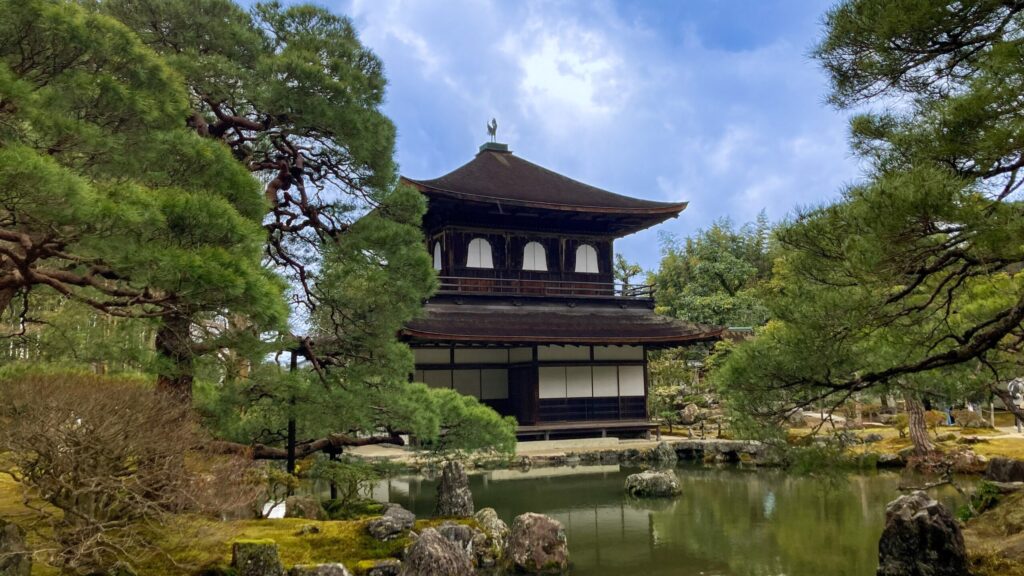
Within the tranquil confines of his villa, Yoshimasa enjoyed watching the rising moon from the ridge of Mt. Tsukimichi on the first floor. The moon was reflected on the pond's surface, its light slowly gliding across the circular stones arranged one by one. Ascending to the upper floor, Yoshimasa would have admired Ginkaku-ji glowing softly in the moonlight, its walls coated in luminous white clay mixed with alum.
In those moments, amid the darkness of his political failures and the 11-year-long Onin War, the tranquil moonlit beauty of Ginkaku-ji may have offered Yoshimasa a quiet sense of hope. Through an unsuccessful shogun in politics, he left a profound cultural legacy by shaping the Higashiyama aesthetic. This artistic tradition gave rise to wabi-sabi, the beauty of simplicity and imperfection.
Yoshimasa's Reign Fails No Matter What He Does
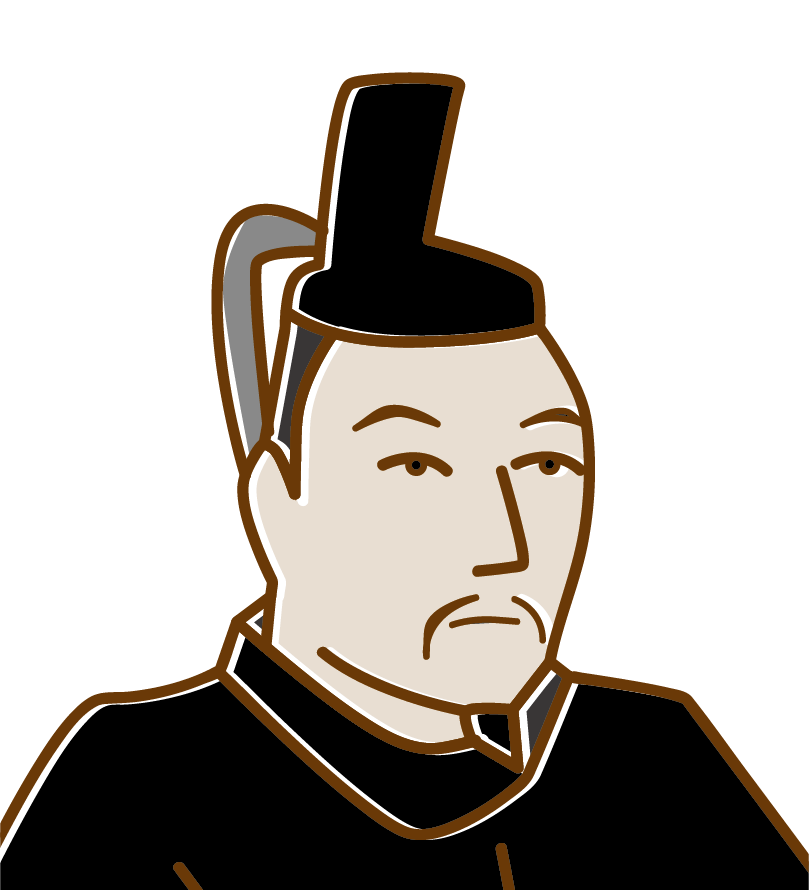
Yoshimasa’s father, the 6th shogun Yoshinori, ruled with an iron fist, implementing a harsh autocratic system known as "administration under Everyone’s fear”. However, in 1441, Yoshinori was unexpectedly assassinated at a banquet by his retainer, Akamatsu Mitsusuke, due to suspicions of imminent punishment. This unprecedented act brought Yoshimasa to inherit the Ashikaga lineage and became the 8th shogun in 1449 upon reaching the age of 14.
Despite his efforts to restore the policies instituted by his respected grandfather, Yoshimitsu, and to eliminate political conflicts among his retainers, Yoshimasa faced persistent challenges, as those around him increasingly prioritized their own interests.
Consequently, his attempts at effective governance faltered. With his dictatorial father no longer in control of the shogunate, power struggles erupted frequently across various regions, accompanied by rebellions by remnants of the Southern Court against the shogunate. Furthermore, a devastating famine caused by drought and prolonged rainfall claimed the lives of over 80,000 people in Kyoto due to starvation. Despite the dire circumstances, many samurai indulged in luxury, while Yoshimasa devoted himself to the expansion and renovation of the shogun’s residence, leading to a financial catastrophe. No measures were taken to alleviate the suffering and hunger of the people. The emperor also admonished Yoshimasa harshly. In a time of social turmoil that demanded strong leadership, Yoshimasa proved to be too weak.
The Onin War Burns Kyoto to the Ground, while Yoshimasa Immerses Himself in Tasteful Elegance
The Onin War erupted due to multiple succession disputes within the shogun family and among influential feudal lords. Shortly after Yoshimasa designated his brother, Yoshimi, as the next shogun, his wife, Tomiko, gave birth to the first heir. Seeking to secure her son’s succession, she aligned herself with the Yamana clan, a move that brought her into direct conflict with the rival Hosokawa clan.
The succession disputes of other prominent feudal clans divided the two sides of the shogunate. In May 1467, fierce battles started in Kyoto, attracting warriors from all corners of Japan. The Western Camp, led by the Yamana clan, fielded 110,000 soldiers, while the Eastern Camp, led by the Hosokawa clan, amassed an army of 160,000 troops. As the conflict escalated, the emperor sought refuge in Yoshimasa’s residence, and the nobles fled to the countryside. Throughout the 11-year-long war, Kyoto was ravaged, with significant temples such as Shorenin, Daigoji, Nanzenji, Shokokuji, Tenryuji, and Kiyomizu falling victim to arson. Yoshimasa’s governance as shogun lost authority, with power shifting toward a meritocratic order among the feudal lords.
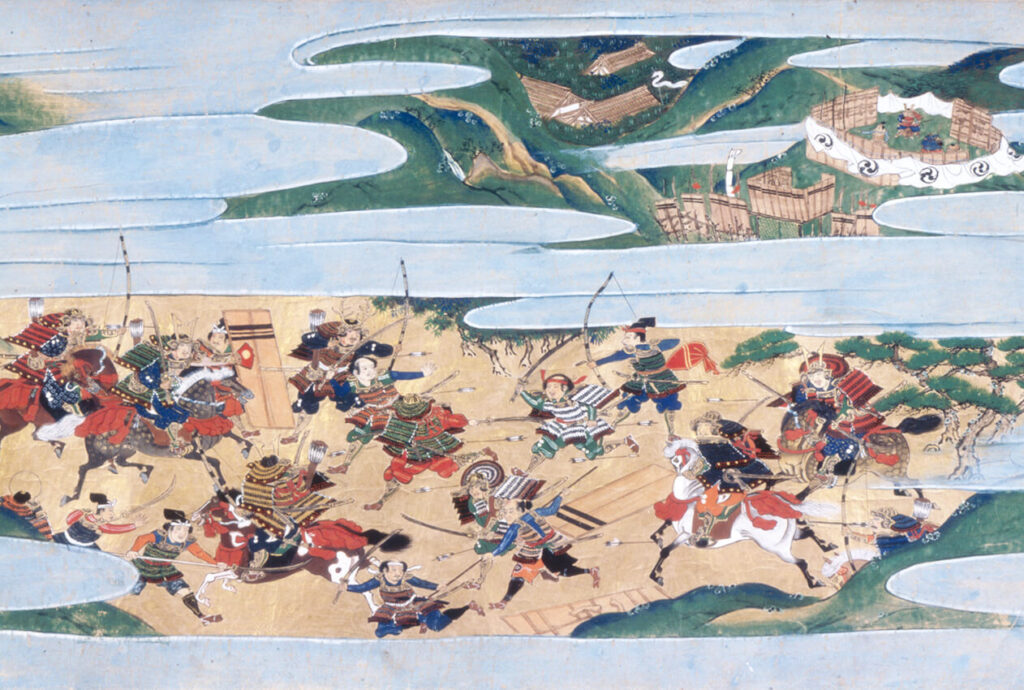
(@ Shinsho Gyokuraku-ji Temple /『真如堂縁起絵巻』真正極楽寺蔵」)
Ginkaku-ji, an Ideal Mountain Villa of Yoshimasa’s Extraordinary Passion
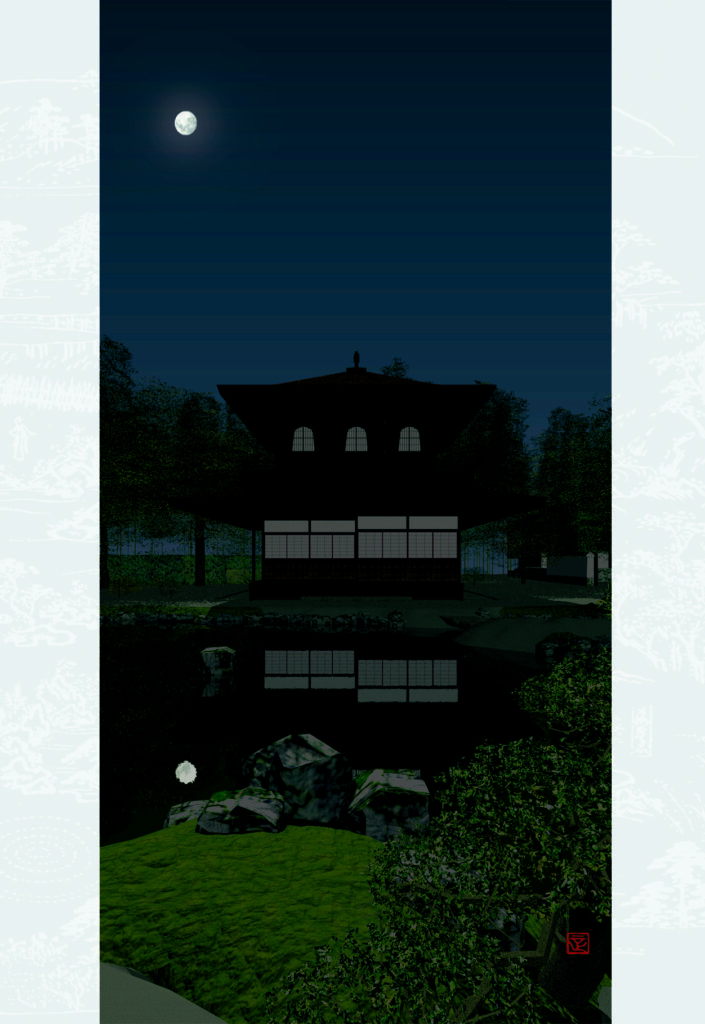
In 1482, Yoshimasa relinquished the position of shogun to his son and began constructing his villa, surrounded by profound silence, far from Kyoto. During its construction, he visited several times and modeled it on Saiho-ji Temple. He was also getting to devote himself to various artistic realms, including waka (Japanese poetry), renga (linked-verse poetry), tea ceremonies, flower arrangements, and so on. Merely three years before his death, the Tōgudō room was completed with a four-and-a-half-tatami layout. Soft light filtered through the shoji screens, and when they were opened, the garden appeared like a single, unified painting. The Tōgudō is regarded as the origin of Japanese shoin-tsukuri architecture, reflecting a conscious awareness of spatial continuity.
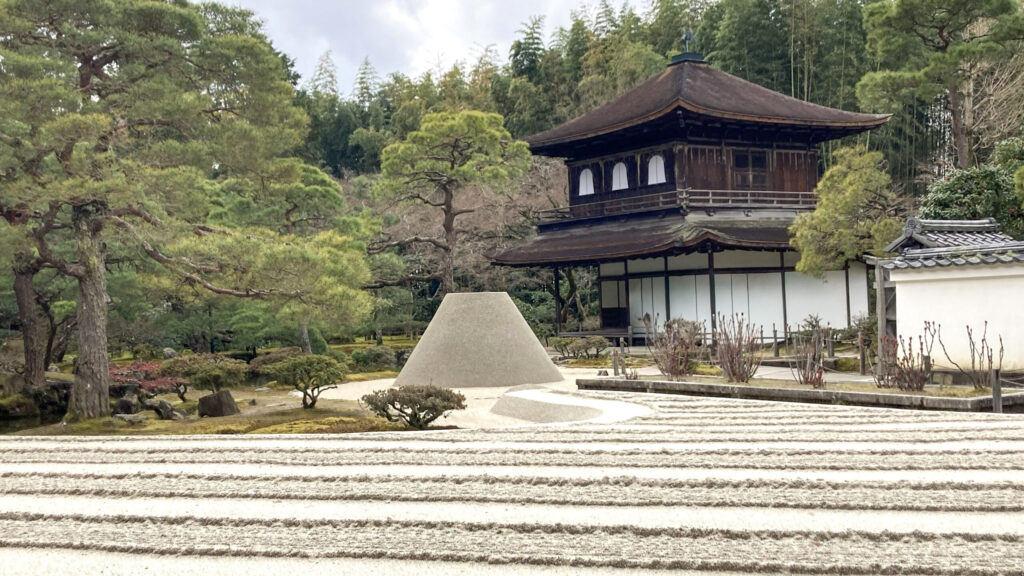
Its style significantly influenced the Japanese sense of beauty in subsequent generations. Yoshimasa died in 1490 at age 55, before the Kannondō (later known as Ginkaku) was completed. During the Edo period (1603-1868), the temple’s allure was further enhanced by incorporating two artificial white sand features, namely ginshadan (resembling the wavy pattern of the silver sand sea) and kōgetsudai (a distinctive mound shaped like Mt.Fuji), by honoring Yoshimasa’s love for the moon.
The Moon-Viewing Temple, Ginkaku-ji
Ginkaku-ji shines in a tranquil atmosphere, encapsulating the essence of ethereal Japanese beauty on moonlit nights. Yoshimasa elevated admiration for the moon to a realm of subtlety and profundity known as yugen, immersing himself in the villa’s ethereal ambiance. As an unparalleled shogun, he revived and laid the foundations of Higashiyama culture, imbuing Japanese aesthetics with enduring beauty even in the aftermath of the destructive Onin War. One of his waka expresses his spiritual state:
I regret the past of my life, but I think my heart is in a state of emptiness, gazing at the moon. (くやしくぞ 過ぎしうき世を 今日ぞ思ふ 心くまなき 月をながめて)
Ashikaga Yoshimasa Timeline
| 1336 | Ashikaga Takauji established Muromachi shogunate | - |
| 1392 | 3rd shogun Ashikaga Yoshimitsu, Yoshimasa's grandfather, unified the Southern and Northern Courts | - |
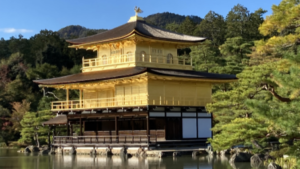
| 1397 | Yoshimitsu constructed Golden Pavillion | - |
| 1408 | Yoshimitsu passed away | - |
| 1436 | Ashikaga Yoshimasa was born | Age=1 |
| 1441 | Ashikaga Yoshinori, Yoshimasa's father, was assassinated | 6 |
| 1449 | Yoshimasa became the 8th shogun | 14 |
| 1464 | Yoshimasa appointed his brother to be the next shogun | 29 |
| 1465 | Yoshimasa had his heir | 30 |
| 1467 | Onin War started (- 1477) | 32 |
| 1474 | Yoshimasa resigned from the shogun | 39 |
| 1477 | Onin war ended | 42 |
| 1483 | Yoshimasa moved to Ginkaku-ji under construction | 48 |
| 1490 | Yoshimasa passed away | 55 |
| 1573 | Muromachi shogunate ended by Oda Nobunaga | - |
Recommendation to Visit
Ginkaku-ji Temple (Silver Pavilion)
- Access: 1 hour from Kyoto Station. Take bus #5 bound for "Ginkaku-ji-Iwakura(銀閣寺・岩倉)” at A1 or bus #17 bound for "Ginkaku-ji(銀閣寺) "at A2. Get off at "Ginkaku-ji-michi (銀閣寺道)" stop, then a 10-minute walk. Or Take the subway bound for "Kokuasai-kaikan (国際会館)" on the Karasuma line. Get off at Imadegawa Station. Then take bus #203 at "Karasuma-Imadegawa (烏丸今出川)" stop bound for "Ginkaku-ji/Kinrin shako-mae (銀閣寺・錦林車庫前)". Get off at "Ginkaku-jimae (銀閣寺前)", then a few-minute walk.