Takeda Shingen, the Strongest Warlord of Sengoku-era, Lost to Time
Dedicated to the Strongest Warlord, Shingen
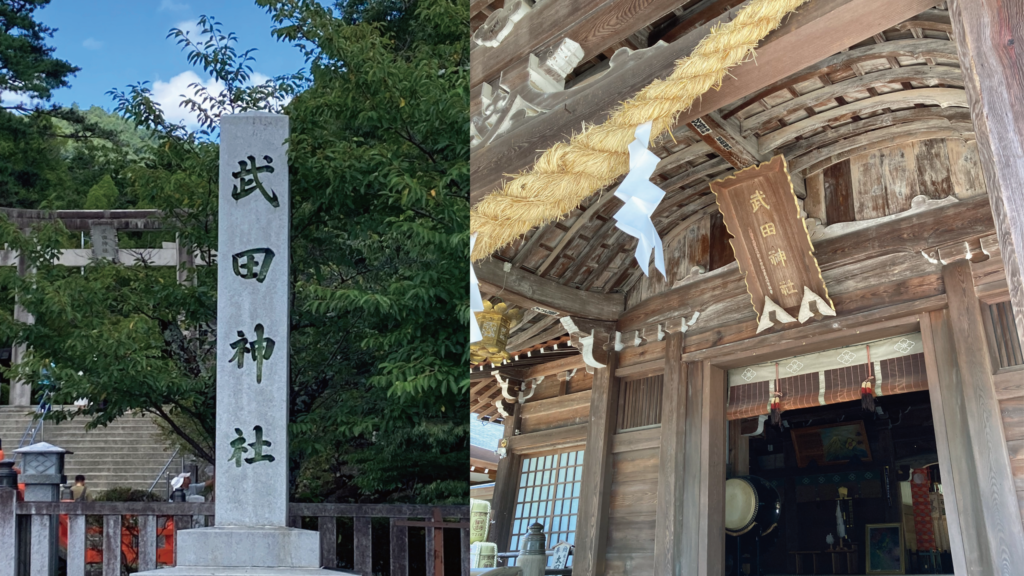
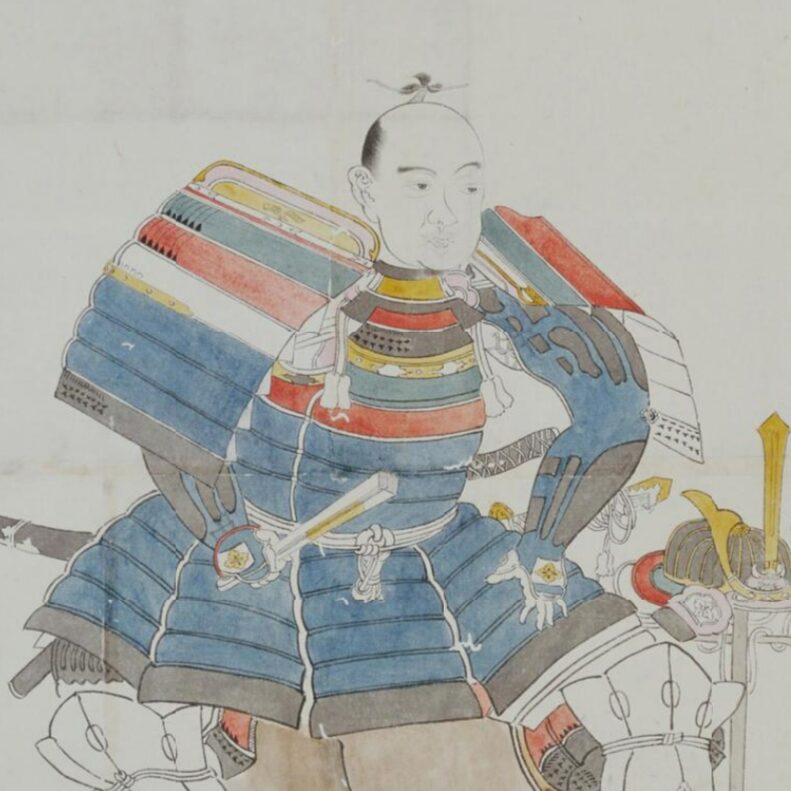
Takeda Shrine was built on the former Tsutsujigasaki residence of Takeda Shingen (1521-1573, 武田信玄). The shrine honors a warlord widely regarded as the strongest of the Sengoku-era (1467-1583), known as the Tiger of Kai.
Shingen's life reads like a masterclass in warfare. He clashed repeatedly with his greatest rival, Uesugi Kenshin (1530-1578, 上杉謙信), known as The Military God, in the legendary Battles of Kawanakajima, a series of fierce engagements spanning over 11 years. As the Imagawa clan declined, Shingen turned south, expanding his power and influence. His alliance with Tokugawa Ieyasu eventually collapsed, especially after Ieyasu allied with Kenshin—Shingen’s sworn enemy, triggering Shingen’s bold westward campaign. The campaign reached its peak at the Battle of Mikatagahara, where Shingen decisively defeated Tokugawa Ieyasu (1543-1616, 徳川家康), a future shogun. Feared even by Oda Nobunaga (1534-1582, 織田信長), Shingen embodied the principles of The Art of War (孫子の兵法), earning a reputation as an almost invincible strategist.
Yet, even the greatest tactician could not overcome time. In the midst of his campaign to march west, illness brought Shingen’s advance—and his life—to an abrupt end. His story is not only one of power and victory, but also a reminder that no strategy can conquer fate itself.
The Birth of Shingen
@ Historiographical Institute The University of Tokyo
In 1521, Shingen was born as the eldest son of Takeda Nobutora, who laid the foundation for the Takeda clan as a warlord in Kai (present day Yamanashi Prefecture), at the foot of Yogaisan mountain, a fallback stronghold, the fortress of Tsutsujigasaki-yakata. His birth occurred during a defensive battle against the forces of the Imagawa clan of Suruga Province. Following his father's victory, he was named Katsuchiyo, meaning bringing the victory. The Takeda clan was a prestigious family descended from the 56th Emperor Seiwa (850-881, 清和天皇) through the Seiwa Genji line. As leaders of a renowned cavalry force that earned fame in many of the nation's most significant battles, they were a seasoned warrior family with a proud tradition of martial excellence. During the Muromachi period (1336-1573), they ruled Kai Province as a shugo daimyō (feudal lord), and later became famous throughout the country as a warlord of the Warring States period. As the heir to the prestigious Takeda clan, Shingen studied classical Confucian texts such as the Four Books and Five Classics, as well as military treatises like The Art of War, Six Secret Teachings, and Three Strategies. These formed the ideological and strategic foundation of the Takeda army.
Fūrinkazan – The Banner of Takeda Forces
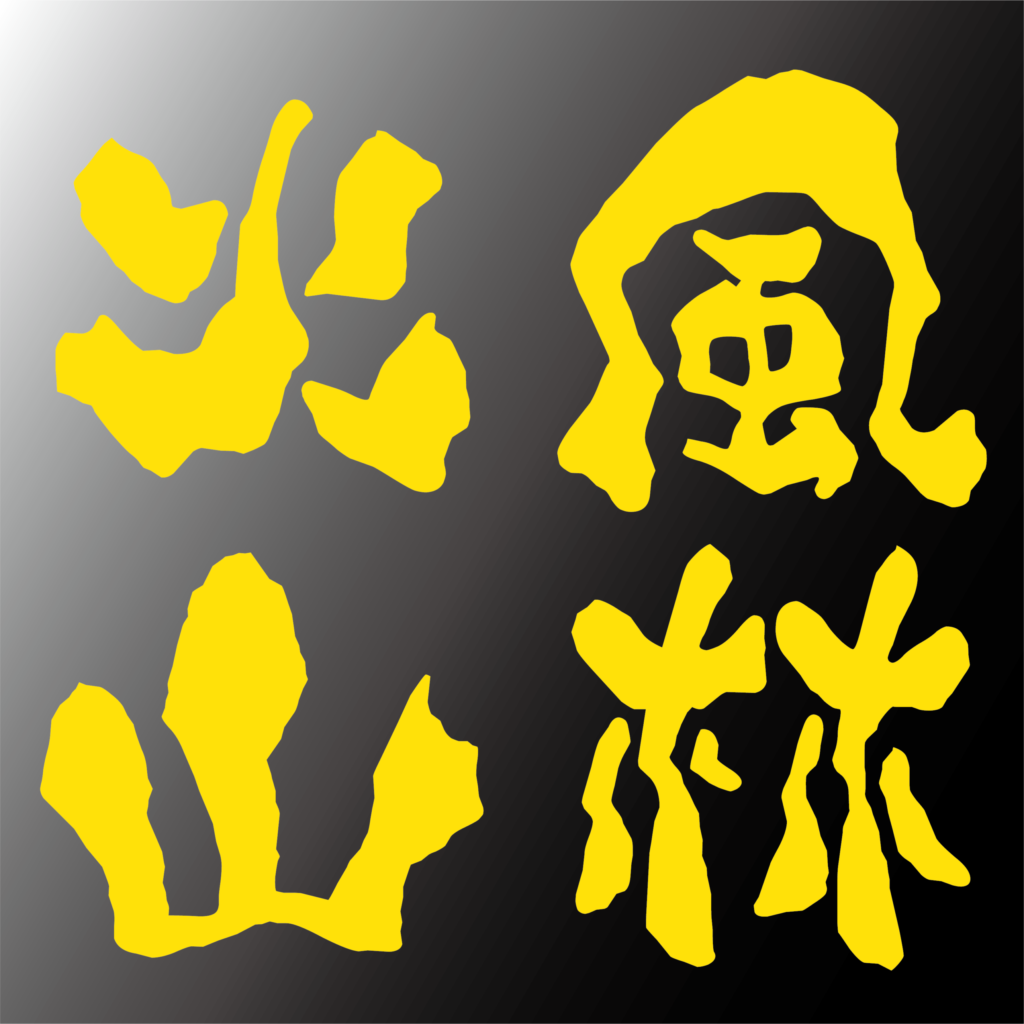
The phrase Fūrinkazan (風林火山) was emblazoned on the Takeda army’s banner. Taken from Sun Tzu's The Art of War, it reads: “Swift as the wind, silent as the forest, fierce as fire, and immovable as a mountain.” The next line continues: “As elusive as shadow, and as thunderous as lightning,” meaning the army should move undetected like darkness and strike as violently as a thunderbolt. This reflected Takeda Shingen’s military philosophy. He deployed Suppa—ninja operatives to infiltrate enemy territory, gather intelligence, conduct assassinations, and set fires during night raids. He also built a structured system to ensure that intelligence collected by the Suppa was delivered directly to him. At the borders, retainers of senior Takeda vassals waited with swift horses, ready to rush information back to Shingen’s headquarters. Shingen planned only those battles he was confident of winning based on the intelligence he had gathered, then launched them as if to prove the soundness of his strategy.
After reporting, the Suppa would return to their post and continue their mission. Behind his numerous military achievements, we can glimpse the strength of Shingen, who placed great importance on intelligence and established an information-gathering system. (Source: HIRAYAMA Yu, “The Reality of Shinobi in the Sengoku Period”)
Shingen’s Great Rivalry: The Battles of Kawanakajima
In 1553, at the age of 33, Shingen confronted Kenshin in northern Shinano at the Battles of Kawanakajima. For Shingen, control of this fertile region was essential - not only to secure provisions for the landlocked provinces of Kai and Shinano, but also to open vital routes to trade along the Sea of Japan. For Kenshin, too, northern Shinano was strategically important, lying close to his Kasugayama Castle. Neither could afford to yield.
Thus began a prolonged and relentless struggle between two of the greatest commanders of the age. Over the course of 11 years, their rivalry remains one of the most dramatic and closely fought contests of the Sengoku era.
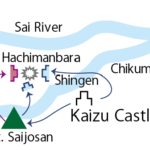
The fourth and most intense of the battles soon unfolded. Shingen positioned his forces at Kaizu Castle along the Chikuma River, while Kenshin occupied Saijōzan. Seeking a decisive blow, Shingen devised a pincer attack; yet Kenshin anticipated the plan, descended under cover of night, and struck first at Hachiman-hara.
As the morning fog lifted, the two armies collided at close quarters. Though divided, the Takeda forces resisted fiercely against Kenshin’s kurumagakari (rotating wave attack formation) assaults until reinforcements arrived and drove the enemy back. The cost, however, was severe: Shingen’s brother Nobushige, the strategist Yamamoto Kansuke, and thousands of soldiers fell. While Shingen retained control of northern Shinano, the battle resulted in heavy losses.
Gaining Access to the Sea – Seizing Suruga
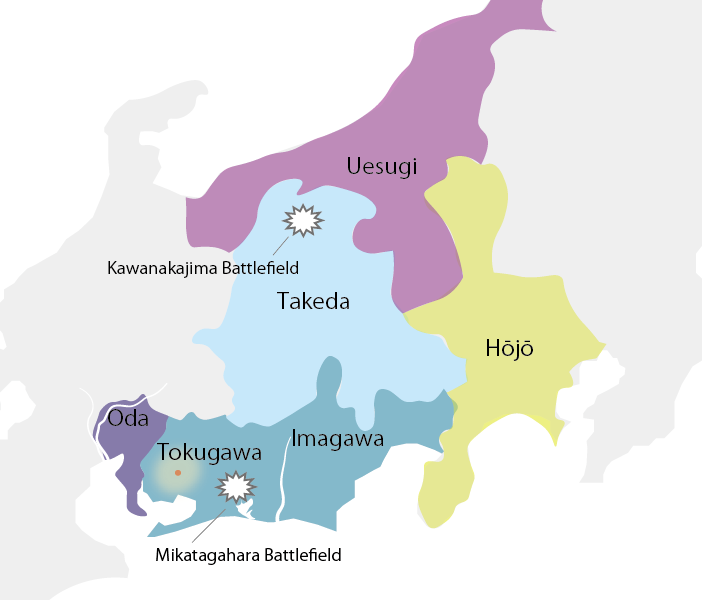
In 1560, following the death of Imagawa Yoshimoto at the Battle of Okehazama defeated by Oda Nobunaga, Shingen's sphere of influence changed dramatically. He successfully brought the coastal Province of Suruga (Shizuoka) under his control. Shingen immediately built a castle at Ejiri (present day Shimizu in Shizuoka prefecture) and appointed Yamagata Masakage, one of Takeda's Four Generals, as its lord. Singen also incorporated seafaring groups in Ise Bay under his command and formed the Takeda navy, the first in the Takeda clan’s history. This enabled him to secure food from the fertile land, seafood, and salt, as well as supply routes for gunpowder and weapons. In 1571, on the eve of the Battle of Mikatagahara, he captured Okitsu Castle in Suruga, further strengthening his naval forces. The Takeda fleet, consisting of one large Atakabune warship and several smaller fast boats, played a key logistical role in his westward campaign, assembling at Omaezaki and sailing along the seacoast to supply the main Takeda army with weapons and provisions by sea.
The Battle of Mikatagahara – The Western Campaign
In 1572, at the age of 52, Shingen launched an invasion of Tokugawa Ieyasu’s territory in Tōtōmi, declaring, “I will vent my three years of pent-up anger,” following Ieyasu's break with him and alliance with his rival, Kenshin. The Battle of Mikatagahara started.
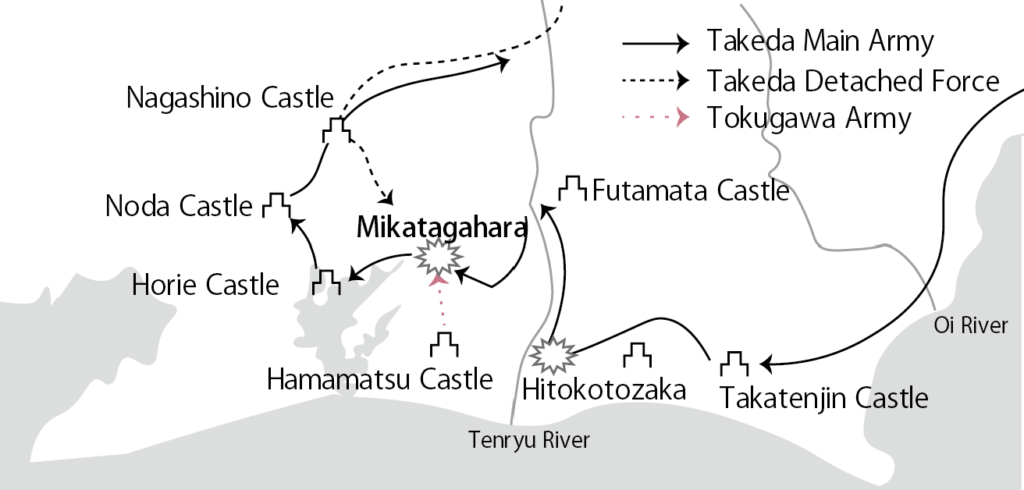
Dividing his forces, Shingen advanced on Hamamatsu Castle. A detached unit under Yamagata Masakage swept through Oumikawa, capturing Tokugawa and Oda strongholds. At the same time, Shingen led the main force of 22,000 troops across the Tenryū River in a coordinated two-pronged westward. As Shingen’s main force neared Hamamatsu, it suddenly turned west and halted at Mikatagahara, where it reversed formation and prepared for battle. Caught off guard, the pursuing Tokugawa army was thrown into confusion, and the Takeda forces, holding the high ground, launched a coordinated downhill attack that resulted in a decisive victory. After thoroughly crushing the Tokugawa forces, defeating over a thousand Tokugawa soldiers, the Takeda army pushed further west, captured Noda Castle north of Lake Hamana, and ravaged Tokugawa-held Mikawa.
In the aftermath, Ashikaga Yoshiaki, shogun of the Muromachi shogunate, urged Shingen to make peace. However, Shingen refused, declaring:
“The rebels Nobunaga and Ieyasu have burned Enryakuji Temple, shown contempt for the Imperial Court, and now behave as though the realm were their own. To leave such men unpunished would amount to the destruction of both Buddhist and imperial law, nothing less than the work of demonic forces. I therefore request an order for their execution. I shall personally uphold the shogun’s authority and restore peace to the realm.”
This declaration can be seen as Shingen stepping forward to assert his role in Tenka Seihitsu (Pacifying the realm), at a time when Nobunaga was increasingly at odds with Yoshiaki.
The Fall of the Great Star, Shingen
In the midst of the siege of Noda Castle, Shingen's life came to an end at the age of 53 in 1573. The Takeda army retreated to Kai. According to Shingen's last wishes, his death was kept secret for three years before a grand funeral was held at Erinji Temple. Shingen had consistently achieved victory by embodying the military strategies of Sun Tzu in numerous battles. However, Shingen lost his sense of urgency just as Sun Tzu placed little emphasis on the concept of time. He spent 11 years on the Battle of Kawanakajima, and it took him about 10 years from the death of Imagawa Yoshimoto to actually begin his invasion of Tōtōmi. At this point, Shingen's life was nearing its end. Sun Tzu's military strategy was both Shingen's strength and his weakness. Following the death of Shingen, his son Katsuyori (1546-1582, 武田勝頼) expanded the Takeda’s territory. However, he was defeated by Oda Nobunaga and Tokugawa Ieyasu in 1582. The remnants of the Takeda clan, including the Takeda cavalry corps and the Takeda navy, were recruited by Ieyasu and fought as part of the Tokugawa forces, continuing their exploits in the Warring States period.
Takeda Shingen Timeline
| 1521 | 1 | Born in Kai Province; childhood name Katsuchiyo | |
| 1536 | 16 | Came of age | |
| 1541 | 21 | Succeeded as Takeda clan head | |
| 1542 | 22 | Launched invasions into Suwa | |
| 1548 | 28 | Defeated by Murakami Yoshikiyo | |
| 1553 | 33 | Fought Uesugi Kenshin in 1st Battle of Kawanakajima | |
| 1555 | 35 | Fought Uesugi Kenshin in 2nd Battle of Kawanakajima | |
| 1557 | 37 | Fought Uesugi Kenshin in 3rd Battle of Kawanakajima | |
| 1558 | 38 | Established Kai Zenkoji Temple | |
| 1560 | 40 | The Battle of Okehazama | |
| 1560 | 40 | Built Kaizu Castle | |
| 1561 | 41 | Fought bloody 4th Battle of Kawanakajima | |
| 1568 | 48 | Invaded Suruga and toppled Imagawa Ujizane | |
| 1571 | 51 | Established Dakeda Navy | |
| 1572 | 52 | Invated into Ieyasu's teritorry, Totoomi | |
| 1573 | 53 | Defeated Tokugawa at Mikatagahara | |
| 1573 | 53 | Died of illness and Entrusted legacy to Katsuyori | |
| 1575 | - | The Battle of Nagashino | |
| 1582 | - | Katsuyori committed suicide |
Recommendations to visit
Takeda Shrine
- Access: 8 minutes by bus from JR Yamanashi Station to Takeda Shrine
Kai Zenkoji Temple
- Access: 12 minutes by taxi from JR Yamanashi Station